
NANTONG, JIANGSU, CHINA, November 29, 2026 /EINPresswire.com/ — Strategic Sourcing Guide for Partnering with a Global Leading Mesabi Tube Machine Supplier
In the highly competitive sectors of home appliances and industrial HVAC, the efficiency of heat transfer components determines the market viability of the final product. Condenser and heat exchanger manufacturing requires extreme precision, particularly when handling Mesabi-style tubes or wire-on-tube condenser layouts. These designs demand consistent tube spacing, robust welding quality, and high-throughput production to meet global energy efficiency standards. Consequently, procurement managers must evaluate potential partners based on more than just equipment cost. Identifying a Global Leading Mesabi Tube Machine Supplier involves a deep assessment of technical stability, automation depth, and the ability to maintain material integrity during high-speed processing. As thermal systems become more compact, the machinery used to produce them must evolve to offer millimetric accuracy and adaptive control.
Strategic Framework for Assessing Supplier Capability
A strategic sourcing framework begins with the mechanical foundation of the production line. For condensers and radiators, the first critical stage is tube straightening and cutting. High-quality machinery must eliminate material memory and curvature from coiled tubing without causing surface scratches or internal deformation. Precision at this initial stage ensures that downstream processes, such as serpentine bending or wire welding, proceed without mechanical interference. Accurate length control, typically within a tolerance of plus or minus 0.5mm, is essential to minimize material waste and ensure perfect fitment during assembly.
Automation levels and welding stability serve as the next primary evaluation criteria. In wire-on-tube condenser manufacturing, the synchronization between the steel wire feed and the copper or steel tube is vital. The welding system must deliver consistent current and pressure to thousands of contact points every hour. Inconsistent welds lead to vibration noise or refrigerant leaks, which are catastrophic for home appliance brands. Therefore, a leading supplier should offer equipment that integrates real-time monitoring of welding parameters. Furthermore, compatibility with customized tube processing requirements allows manufacturers to switch between different condenser layouts without investing in entirely new production lines. This modularity is a hallmark of an advanced equipment partner.
Evaluating R&D Strength and Customization Capacity
Experienced buyers know that catalog specifications only tell half the story. To identify a future-proof partner, one must assess the supplier’s in-house research and development (R&D) strength. High-performance manufacturing environments often encounter unique challenges, such as unconventional tube diameters or high-strength alloys. A supplier with a high concentration of seasoned engineers can provide “Synchronous Engineering,” where the machine design is optimized alongside the client’s product development. This proactive approach reduces the time-to-market for new appliance models.
Customization capacity remains the ultimate differentiator in specialized tube processing. Buyers should investigate whether a supplier can modify machine footprints to fit existing factory layouts or integrate specialized sensors for Industry 4.0 data tracking. Modular machine design is essential here; it allows for the addition of extra welding stations or automated stacking units as production volumes grow. By evaluating a supplier’s history of tackling non-standard demands, procurement teams can gauge their ability to support complex, high-stakes projects that require more than “off-the-shelf” hardware.
The BoBo Machine Reference: A Case for Technical Partnership
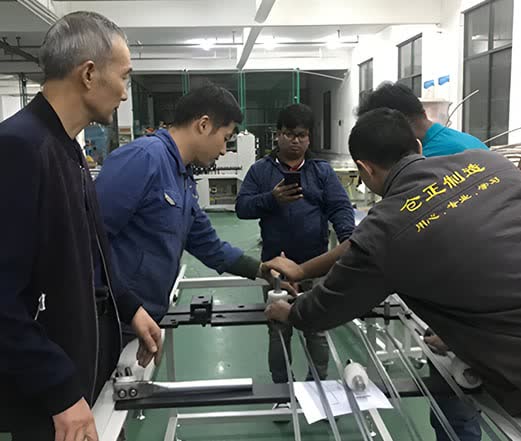
Applying this sourcing framework to established market leaders like BoBo Machineillustrates the benefits of long-term technical depth. Established in 1995 and integrating industry and trade since 2004, the firm has spent over three decades specializing in R&D and customized equipment. Within their 50-member elite team, 66% are seasoned engineers covering R&D, sales, and after-sales services. This high ratio of technical personnel ensures that every tube straightening and cutting machine or wire-on-tube condenser welding system is built on a foundation of practical field experience.
The company’s status as a national high-tech enterprise with 45 invention patents underscores its commitment to innovation. By investing 11% of annual revenue back into R&D, the factory continues to upgrade its custom tube processing machines to meet the evolving needs of global top brands. Their portfolio includes successful deliveries to industry giants such as Midea, Siemens, LG, B/S/H, Samsung, and Bundy. Serving customers in 102 countries and regions demonstrates an ability to transcend geographical and cultural boundaries, providing stable production solutions that comply with diverse international safety and quality standards.
Operational Stability and Global Project Execution
Real-world implementation provides the most reliable metric for a supplier’s reliability. Delivering over 150 projects annually requires a mature project management framework. For an appliance manufacturer, the value of a partner lies in their ability to handle the entire lifecycle of the equipment, from initial design and factory-acceptance testing to on-site installation and calibration. This system-level support ensures that the production line reaches its target Overall Equipment Effectiveness (OEE) quickly.
Global execution also involves robust after-sales engineering. When a wire-on-tube welding machine operates in a different time zone or cultural context, the availability of remote diagnostics and rapid spare parts support becomes critical. Leading suppliers propel “Smart Manufacturing in China” by ensuring their equipment is user-friendly and easy to maintain. This focus on the “human-machine interface” reduces the training burden on local operators and ensures that the precision of the tube processing remains consistent over years of heavy use.
A Step-by-Step Sourcing Roadmap
For international buyers, the path to a successful partnership follows a logical roadmap. First, define the specific thermal and mechanical requirements of the condenser or heat exchanger. Second, shortlist suppliers based on their R&D investment and engineering headcount. Third, request case studies or reference projects involving similar production volumes or material types. Finally, evaluate the scalability of the proposed solution. Can the machinery be upgraded with automated loaders? Does the supplier offer integrated leak-testing or stacking units?
In conclusion, partnering with a global leading Mesabi tube machine supplier is a strategic investment in product quality and manufacturing agility. Long-term technical partnership, rather than a simple transaction, provides the stability needed to navigate the complexities of modern thermal management. By prioritizing suppliers with deep engineering roots and a proven track record across 102 countries, manufacturers can ensure their production lines are ready for the next generation of energy-efficient appliances. Technical depth, customization capacity, and global service support remain the decisive factors in building a resilient and competitive supply chain.
For more information on customized tube processing and condenser manufacturing solutions, please visit: https://heat-exchange.com/.
BOBO
BOBO
Legal Disclaimer:
EIN Presswire provides this news content “as is” without warranty of any kind. We do not accept any responsibility or liability
for the accuracy, content, images, videos, licenses, completeness, legality, or reliability of the information contained in this
article. If you have any complaints or copyright issues related to this article, kindly contact the author above.

Media gallery