Piston pumps account for approximately USD 1.16 billion in 2025 revenue, serving high-pressure industrial dosing requirements.
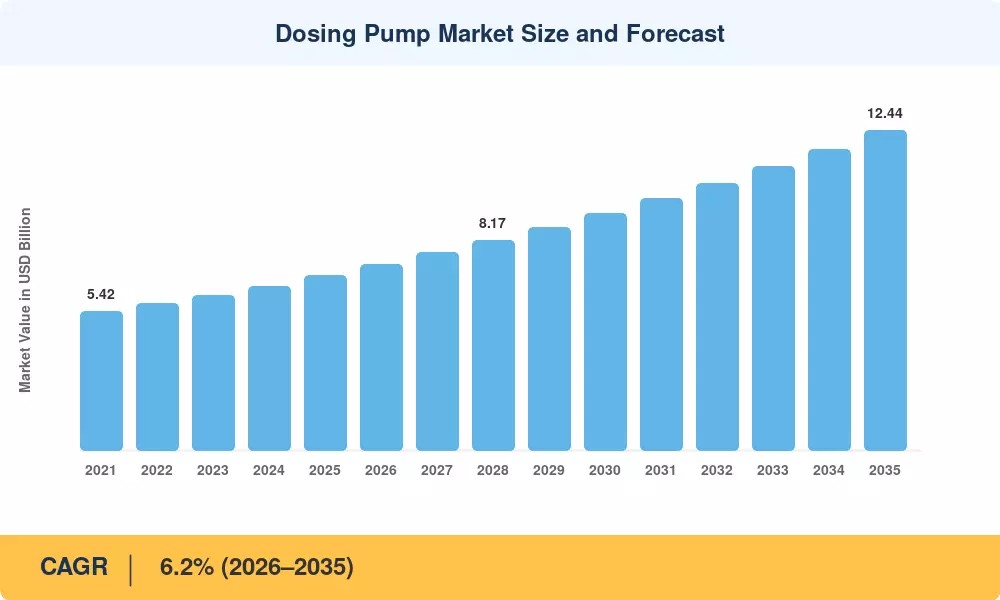
NEW YORK, NY, UNITED STATES, July 29, 2026 /EINPresswire.com/ — The global Dosing Pump Market reached an estimated USD 6.82 billion in 2025 and is projected to grow from USD 7.24 billion in 2026 to USD 12.44 billion by 2035, registering a CAGR of 6.2% during the forecast period (2026–2035).
Market Overview
Dosing pumps are precision positive displacement devices designed to inject chemicals, additives, or treatment agents into fluid streams at highly controlled flow rates. These pumps are essential for accurate metering of coagulants, disinfectants, pH adjusters, corrosion inhibitors, and other process chemicals across water treatment, chemical processing, oil and gas, pharmaceutical manufacturing, and food and beverage production. Unlike standard centrifugal pumps, dosing pumps maintain consistent flow regardless of pressure variations, delivering accuracy typically within ±1% of setpoint. The market encompasses diaphragm, piston, peristaltic, and solenoid pump technologies, with configurations ranging from simple manual systems to advanced digitally controlled platforms with real-time sensor feedback and cloud connectivity.
The market’s steady growth is anchored in tightening water quality regulations across both developed and emerging economies, which represent the principal catalyst behind this expansion. The U.S. EPA’s revised Lead and Copper Rule (effective 2024) and the EU’s updated Drinking Water Directive (2020/2184) require utilities to deploy precise chemical dosing infrastructure, creating sustained capital spending cycles that anchor demand through the decade. The World Bank’s USD 30 billion commitment to water and sanitation infrastructure (2023–2028) is accelerating this upgrade cycle across South Asia, Sub-Saharan Africa, and Latin America, with chemical dosing systems essential to every treatment node.
A notable technology transformation is reshaping the market as legacy manual dosing systems—prone to over- or under-dosing by as much as 15–20%—are giving way to digitally controlled, sensor-integrated platforms that adjust chemical feed rates in real time. Manufacturers are bundling hardware with cloud-based monitoring, predictive maintenance, and chemical procurement under subscription models that lower capital barriers while creating recurring revenue streams. The integration of IoT connectivity, AI-driven optimization algorithms, and remote diagnostics is enabling autonomous dosing operations that reduce chemical consumption by 15–25% while improving regulatory compliance.
Asia-Pacific dominates the market with approximately 38% revenue share, driven by massive municipal water treatment buildouts in China and India, while also recording the fastest growth at a projected CAGR of 7.4%. North America holds the second-largest share at roughly 26%, underpinned by stringent environmental compliance mandates, with Europe following at 22% driven by strong demand from pharmaceutical and food-processing sectors. As industrial water reuse and zero-liquid-discharge policies gain traction worldwide, the dosing pump market is positioned for sustained structural growth through 2035.
Get Free Sample Report for Detailed Market Insights:
https://www.marketresearchfuture.com/sample_request/8765
Market Segmentation
The Dosing Pump Market is comprehensively segmented across type, application, and end-user categories to capture diverse industry dynamics and regional requirements.
By type, diaphragm pumps command approximately 42% of the market, favored for chemical resistance and low maintenance across water treatment and chemical processing facilities. Mechanical and hydraulic diaphragm variants serve applications ranging from municipal chlorination to industrial acid dosing, with their dominance reinforced by a wide range of wetted-material options including PTFE, PVDF, and PP that can be matched to virtually any chemical service. Peristaltic pumps are the fastest-growing type segment, registering an estimated CAGR of 8.1%, owing to expanding pharmaceutical and food-grade applications where hygienic design and zero cross-contamination are non-negotiable. The tube-based pumping mechanism eliminates seal failures and allows operators to change fluid paths in minutes, with the biologics sector expanding at over 10% annually positioning peristaltic technology to capture increasing market share. Piston pumps account for approximately USD 1.16 billion in 2025 revenue, serving high-pressure industrial dosing requirements, while solenoid pumps hold approximately 11% share for low-flow, cost-sensitive applications.
By application, water and wastewater treatment represents the dominant segment holding roughly 36% share, as municipal utilities dose chlorine, fluoride, coagulants, and pH adjusters at multiple points in the treatment train. Rising water reuse mandates are adding tertiary treatment dosing points that expand equipment requirements per facility. Oil and gas applications are projected to grow at a CAGR of 5.8% as corrosion-inhibitor and scale-treatment programs expand globally, particularly in shale basins and offshore production. Chemical processing accounts for USD 1.23 billion in 2025, driven by catalyst dosing and pH control requirements. Pharmaceutical applications represent the fastest-growing end-use at 7.9% CAGR, with precision requirements in bioprocessing where dosing accuracy of ±1% is critical for cell viability, supported by global pharmaceutical capex exceeding USD 50 billion in 2024. Food and beverage applications account for approximately 12% share, driven by CIP processes and additive metering, while mining and pulp and paper represent the remaining share for flotation reagents and bleaching chemicals.
By end-user, industrial facilities constitute the largest buyer group at approximately 48% share, spanning chemical plants, refineries, power stations, and semiconductor fabs that typically maintain dozens of dosing pumps across multiple chemical services. Municipal end-users are growing fastest at 6.8% CAGR as governments in India, China, Brazil, and Africa pour capital into public water supply and sanitation infrastructure.
You can buy this market report at:
https://www.marketresearchfuture.com/checkout?currency=one_user-USD&report_id=8765
Regional Analysis
Asia-Pacific leads the Dosing Pump Market with 38% share, with China contributing over USD 1.30 billion in 2025 through aggressive municipal wastewater expansion under the 14th Five-Year Plan, which targets over 100 new wastewater treatment facilities. India is the fastest-growing country at 8.3% CAGR, driven by the Jal Jeevan Mission Phase 2 extending chemical dosing requirements to hundreds of thousands of rural water nodes, while zero-liquid-discharge mandates for textile and tannery sectors are converting previously unregulated industrial facilities into active buyers. Japan and South Korea contribute high-value demand from semiconductor fab and bioprocessing facilities requiring ultra-precise metering with ±0.5% accuracy.
North America holds the second-largest share at roughly 26%, with the United States accounting for 82% of regional revenue driven by the EPA’s Lead and Copper Rule Revisions triggering procurement cycles for corrosion-control dosing equipment across approximately 50,000 community water systems. Continued investment in Permian Basin and Marcellus Shale water treatment sustains oil and gas demand, while Canada’s federal commitment to resolving long-term drinking water advisories on First Nations reserves generates steady demand for containerized dosing systems.
Europe follows at 22%, characterized by a mature installed base transitioning toward digital and IoT-connected platforms. Germany leads with 28% of European share through its strong chemical and pharmaceutical manufacturing base, while the UK’s AMP8 regulatory cycle (2025–2030) has earmarked over GBP 88 billion for water infrastructure, a significant portion flowing into chemical dosing upgrades. France contributes through nuclear cooling water and food processing applications, with the EU Drinking Water Directive compliance driving upgrades across all member states.
The Middle East & Africa region presents the highest growth trajectory outside Asia-Pacific at 6.9% CAGR, with Saudi Arabia’s Vision 2030 mega-projects including NEOM incorporating advanced water treatment facilities requiring comprehensive chemical dosing infrastructure. Desalination mega-projects in Saudi Arabia and the UAE are fueling demand, as these facilities rely heavily on precise anti-scalant, coagulant, and chlorine dosing at multiple process stages. South America, led by Brazil’s partial privatization of state water utility SABESP unlocking USD 7.4 billion in infrastructure investment, and Chile’s copper mining sector relying on chemical dosing for flotation and tailings treatment, represents a smaller but growing market.
Competitive Landscape
The Dosing Pump Market is moderately consolidated, with the top five companies estimated to control approximately 35–40% of global revenue and an estimated Herfindahl-Hirschman Index of 650–800 indicating moderate competition. European manufacturers hold outsized market positions due to engineering heritage and global distribution networks, while the competitive environment is intensifying as digitalization lowers barriers between pump OEMs and software-first entrants.
Grundfos holds 8–11% market share through its digital diaphragm pumps and smart dosing systems, positioning as a full-stack digital water solutions provider with the March 2025 launch of the SMART Digital DDA 200 dosing pump series featuring embedded AI flow verification and cloud connectivity. ProMinent commands 7–10% share as a pure-play dosing specialist offering metering pumps, controllers, and complete dosing stations. IDEX Corporation (Pulsafeeder) holds 6–8% through electronic and hydraulic diaphragm pumps within a diversified fluid-handling portfolio. Xylem, with 5–7% share, strengthened its position through the September 2024 integration of Evoqua Water Technologies’ dosing portfolio across peristaltic and diaphragm pumps, becoming a top-three player in North America. Verder (Verderflex) holds 4–6% with a heavy-duty industrial focus on peristaltic hose pumps, while Milton Roy (Accudyne) commands 4–6% specializing in controlled-volume metering pumps for oil and gas and chemical applications. Other significant players include LEWA GmbH, Watson-Marlow, Iwaki Co., and SEKO S.p.A.
Major companies are investing heavily in digital dosing platforms, outcome-based service models, and IoT connectivity to create sticky customer relationships and recurring software revenue that decouples growth from pump unit sales, fundamentally shifting competitive dynamics away from hardware specifications toward lifecycle value and data-driven services.
Latest Industry News & Developments
In March 2025, Grundfos launched the SMART Digital DDA 200 dosing pump series with embedded AI flow verification and cloud connectivity, targeting municipal water utilities upgrading to autonomous dosing operations. In September 2024, Xylem completed the integration of Evoqua Water Technologies’ dosing portfolio, consolidating its position as a top-three player in the dosing pump market across North America. In October 2024, the U.S. EPA published final implementation guidance for the Lead and Copper Rule Revisions, triggering procurement cycles for corrosion-control dosing equipment across approximately 50,000 community water systems.
Market Challenges & Opportunities
High upfront capital costs for digital systems represent a significant challenge, as advanced dosing pump systems integrated with IoT sensors, PLCs, and cloud-based diagnostic platforms carry a substantial price premium compared to simple manual alternatives, posing a significant adoption barrier for water utilities in emerging economies. Skilled labor shortages, with an estimated 2.8 million skilled water sector technician shortfall in Asia-Pacific according to ILO estimates, restrict equipment uptime and deter digital upgrades. Chemical compatibility failures remain a persistent source of unplanned downtime, with a 2023 AWWA survey reporting that 28% of U.S. water utilities experienced at least one dosing pump failure per year attributed to chemical corrosion.
However, significant opportunities are emerging across multiple dimensions. Smart dosing-as-a-service models that bundle hardware with cloud-based monitoring, predictive maintenance, and chemical procurement under subscription arrangements can tap recurring revenue streams while lowering capital barriers for small utilities, reducing total cost of ownership by an estimated 20–30%. Emerging-market water buildouts across Sub-Saharan Africa and South Asia, where Africa’s urban population is projected to double by 2050 requiring entirely new water treatment infrastructure, represent largely untapped opportunities where current penetration of automated dosing remains below 15%. Zero-liquid-discharge industrial mandates in India, China, and other markets are converting previously unregulated industrial facilities into active buyers of dosing equipment. Pharmaceutical cleanroom expansion post-pandemic is generating demand for high-purity dosing systems, with new facilities in India, South Korea, and Ireland requiring FDA- and EMA-compliant metering systems. Data monetization through dosing analytics, where digital platforms generate continuous operational data that can be monetized through benchmarking services and optimization consulting, allows equipment OEMs to create high-margin software revenue.
To explore more market insights, visit us at:
https://www.marketresearchfuture.com/reports/dosing-pump-market-8765
Final Market Summary
The Dosing Pump Market is positioned for sustained and robust growth, with projections indicating a near-doubling of market value from USD 6.82 billion in 2025 to USD 12.44 billion by 2035, at a CAGR of 6.2%. This expansion is underpinned by tightening drinking water regulations, massive municipal water infrastructure investment, desalination capacity expansion, and pharmaceutical production growth, with digitalization and IoT integration fundamentally reshaping the technology landscape. While challenges including high upfront capital costs, skilled labor shortages, and chemical compatibility failures persist, emerging opportunities in smart dosing-as-a-service models, emerging-market water buildouts, zero-liquid-discharge mandates, and data analytics platforms offer significant potential for industry participants. The future market landscape will be defined by companies that successfully transition from hardware sales to digital service platforms, navigate evolving regulatory requirements, and establish strong aftermarket and recurring revenue capabilities, with Asia-Pacific set to dominate global growth through massive municipal water and industrial infrastructure development.
More Related Reports from MRFR Library:
Crude Oil Carrier Market: https://www.marketresearchfuture.com/reports/crude-oil-carrier-market-6693
Demand Response Management System Market: https://www.marketresearchfuture.com/reports/demand-response-management-system-market-6694
Solar PV Glass Market: https://www.marketresearchfuture.com/reports/solar-pv-glass-market-6717
Grid Scale Battery Market: https://www.marketresearchfuture.com/reports/grid-scale-battery-market-6781
Cryogenic Valve Market: https://www.marketresearchfuture.com/reports/cryogenic-valve-market-6783
Digital Oilfield Market: https://www.marketresearchfuture.com/reports/digital-oilfield-market-6784
Electrical Bushing Market: https://www.marketresearchfuture.com/reports/electrical-bushing-market-6810
Oil & Gas Sensors Market: https://www.marketresearchfuture.com/reports/oil-gas-sensors-market-6965
Electric Insulator Market: https://www.marketresearchfuture.com/reports/electric-insulator-market-6969
Steam Boiler Market: https://www.marketresearchfuture.com/reports/steam-boiler-market-6972
Larry Wilson
WantStats Research And Media Pvt. Ltd.
+ +1 855-661-4441
email us here
Visit us on social media:
LinkedIn
Facebook
YouTube
X
Legal Disclaimer:
EIN Presswire provides this news content “as is” without warranty of any kind. We do not accept any responsibility or liability
for the accuracy, content, images, videos, licenses, completeness, legality, or reliability of the information contained in this
article. If you have any complaints or copyright issues related to this article, kindly contact the author above.

Media gallery