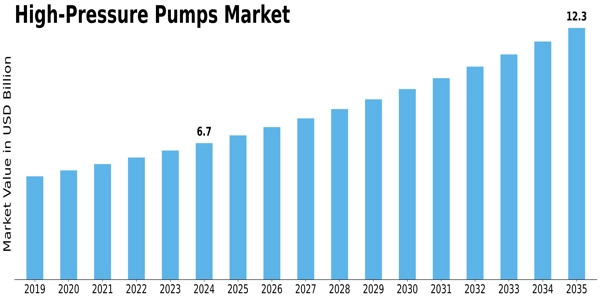
Growing adoption of high-pressure pumping technologies due to increasing industrial automation is a major market driver.
NEW YORK, NY, UNITED STATES, September 22, 2026 /EINPresswire.com/ — According to Market Research Future, the High-Pressure Pumps Market is projected to grow from 3290.30 USD Billion in 2024 to 4662.82 USD Billion by 2035, reflecting a robust growth trajectory. This substantial expansion reflects the indispensable role of high-pressure pumping technology across critical industries, where these powerful machines perform essential functions ranging from water treatment and chemical processing to oil and gas extraction, power generation, and precision manufacturing. The market’s consistent growth is underpinned by rising industrialization, increasing demand for water and wastewater management, expanding energy production, and continuous technological advancements in pump efficiency, automation, and materials science.
Market Overview
High-pressure pumps are engineered systems designed to move liquids and slurries at elevated pressures, typically exceeding 100 bar, enabling applications that require significant force to overcome resistance, achieve atomization, or transport fluids across long distances and elevations. These pumps encompass a diverse range of technologies, including positive displacement pumps, rotodynamic pumps, plunger pumps, and diaphragm pumps, each optimized for specific pressure, flow, and fluid characteristics. They serve critical functions across water and wastewater treatment, industrial processes, oil and gas operations, chemical processing, and power generation, making them essential enablers of modern industrial infrastructure.
The growth drivers for the high-pressure pumps market are diverse and mutually reinforcing. Rising global demand for water and wastewater treatment stands as a primary catalyst, as municipalities and industries invest in desalination, membrane filtration, and reverse osmosis systems that require high-pressure pumps to force water through semi-permeable membranes. Water scarcity concerns, driven by population growth, climate change, and industrialization, are accelerating investment in water treatment infrastructure globally. The growing adoption of desalination technologies in water-stressed regions, including the Middle East, North Africa, and parts of Asia and the Americas, creates sustained demand for high-pressure pumps capable of withstanding corrosive seawater and delivering reliable performance.
Industrial process intensification represents another significant growth driver, as manufacturers across chemical, pharmaceutical, food and beverage, and petrochemical sectors require high-pressure pumping for reactions, homogenization, and material transfer. The shift toward continuous processing, higher pressures, and more demanding operating conditions is driving demand for advanced pump technologies with superior reliability, efficiency, and contamination control. The expansion of the pharmaceutical and biotechnology industries, including vaccine production and biologics manufacturing, creates demand for precision high-pressure pumps with stringent cleanliness and accuracy requirements.
Technological developments are reshaping the high-pressure pump landscape at an accelerating pace. Energy efficiency has emerged as a critical focus, with manufacturers developing pumps that deliver higher pressures while consuming less energy. Variable frequency drives, advanced impeller designs, and optimized hydraulic profiles are improving efficiency across all pump categories. The integration of IoT sensors, predictive analytics, and remote monitoring capabilities is enabling condition-based maintenance, reducing downtime, and extending equipment lifespan.
Materials science advancements are enabling pumps to handle more challenging fluids at higher pressures and temperatures. Ceramic plungers, advanced alloys, and composite materials are improving wear resistance, corrosion resistance, and operational reliability. Sealing technologies are evolving to eliminate leakage and extend maintenance intervals, addressing environmental and safety concerns. The Manifold Absolute Pressure Sensor Market demonstrates how precision sensing technology supports pump and engine management systems, with these sensors providing critical data for optimizing combustion and fluid delivery.
The demand outlook for high-pressure pumps remains robust, supported by global infrastructure investment, energy production growth, and industrial expansion. The Fuel Pumps Market represents a related segment within the broader pump industry, serving automotive and transportation applications that require reliable fuel delivery under pressure.
📍 Get Free Sample Report for Detailed Market Insights:
https://www.marketresearchfuture.com/sample_request/1880
Market Segmentation
The high-pressure pumps market is segmented based on application, type, end use, pump drive type, and regional analysis to provide a comprehensive understanding of the industry landscape.
By Application: The market is categorized into Water and Wastewater Treatment, Industrial Processes, Oil and Gas, Chemical Processing, and Power Generation. Water and wastewater treatment represents a significant application segment, driven by desalination, membrane filtration, and reverse osmosis systems that require high-pressure pumps to overcome osmotic pressure and achieve efficient separation. Oil and gas applications encompass enhanced oil recovery, hydraulic fracturing, and pipeline transportation, where high-pressure pumps inject fluids into reservoirs and transport hydrocarbons across long distances. Power generation applications include boiler feed, cooling water circulation, and emissions control systems, with high-pressure pumps essential for maintaining operational efficiency and regulatory compliance. Chemical processing and industrial processes demand precision pumping for reactions, mixing, and material transfer under demanding conditions.
By Type: The market is divided into Positive Displacement Pumps, Rotodynamic Pumps, Plunger Pumps, and Diaphragm Pumps. Positive displacement pumps deliver fixed volumes of fluid with each cycle, making them suitable for high-pressure, low-flow applications requiring precise metering. Rotodynamic pumps, including centrifugal and axial designs, use rotating impellers to impart energy to fluids, offering high flow rates and continuous operation. Plunger pumps represent a type of positive displacement pump using reciprocating plungers to generate high pressures, commonly used in oil and gas, water treatment, and industrial cleaning applications. Diaphragm pumps use flexible membranes to displace fluids, offering excellent chemical compatibility and contamination-free operation for pharmaceutical, food, and chemical applications.
By End Use: The market is segmented into Construction, Mining, Agriculture, Food and Beverage, and Pharmaceuticals. Construction applications include concrete pumping, pressure washing, and dust suppression, where high-pressure pumps deliver water and slurries at required pressures. Mining operations use high-pressure pumps for dewatering, hydraulic fracturing, and ore processing, with equipment required to withstand abrasive and corrosive conditions. Agriculture applications encompass irrigation, fertigation, and pesticide application, with high-pressure pumps ensuring uniform distribution across fields. Food and beverage processing requires high-pressure pumps for homogenization, sterilization, and cleaning-in-place systems. Pharmaceutical applications demand precision high-pressure pumps for drug formulation, sterilization, and aseptic processing.
By Pump Drive Type: The market is categorized into Electric, Diesel, Hydraulic, and Pneumatic drives. Electric drives dominate the market, offering clean, efficient, and precise operation with easy integration into automated systems. Diesel drives serve remote and mobile applications where electrical infrastructure is unavailable, providing reliable power for construction, mining, and oil field operations. Hydraulic drives use pressurized fluid to power pumps, offering high power density and precise control for demanding applications. Pneumatic drives use compressed air to operate pumps, offering safety in hazardous environments and simplicity in operation.
By Region: The market analysis covers North America, Europe, South America, Asia Pacific, and Middle East and Africa. Asia Pacific dominates the global market, driven by massive industrialization, infrastructure investment, and water treatment needs across China, India, and Southeast Asian nations.
🛒 You can buy this market report at:
https://www.marketresearchfuture.com/checkout?currency=one_user-USD&report_id=1880
Regional Analysis
Asia-Pacific represents the largest and fastest-growing regional market for high-pressure pumps, driven by massive industrialization, infrastructure investment, and expanding water treatment needs. China leads the region as the world’s largest pump market, supported by extensive manufacturing, energy production, and water infrastructure development. The country’s aggressive investment in desalination, wastewater treatment, and industrial capacity creates sustained demand for high-pressure pumps across all application segments. India is emerging as a significant growth market, driven by water infrastructure investment, power generation expansion, and industrial development. Japan and South Korea maintain strong demand for advanced, high-efficiency pumps, with focus on precision manufacturing and energy efficiency. Southeast Asian nations, including Indonesia, Vietnam, and Thailand, are experiencing rapid pump demand growth as industrialization accelerates and water infrastructure develops.
North America remains a mature yet dynamic market, characterized by advanced industrial infrastructure, stringent environmental regulations, and strong replacement demand. The United States leads regional demand, driven by oil and gas production, water treatment infrastructure, power generation, and industrial manufacturing. The region is at the forefront of pump automation and smart monitoring adoption, with operators investing in connected systems that optimize performance and reduce maintenance costs. Canada maintains significant demand for high-pressure pumps in oil sands operations, mining, and hydroelectric power generation. Mexico is emerging as a manufacturing hub, with pump demand driven by industrial expansion and infrastructure development.
Europe represents a technologically advanced market with strong emphasis on energy efficiency, environmental sustainability, and precision engineering. Germany leads regional consumption with its dominant industrial and manufacturing base, home to leading pump manufacturers including KSB, Wilo, and Grundfos. The region’s stringent environmental regulations, including the Water Framework Directive and Industrial Emissions Directive, are driving investment in advanced water treatment and industrial process pumps. The European Union’s focus on energy efficiency and carbon reduction is accelerating adoption of high-efficiency pumps and variable speed drives. France, Italy, and the United Kingdom maintain significant demand across water, energy, and industrial applications.
South America and Middle East & Africa represent emerging markets with substantial growth potential. South American markets, particularly Brazil, show steady growth supported by mining, oil and gas, and water infrastructure investment. The Middle East demonstrates strong demand for high-pressure pumps driven by desalination, oil and gas production, and industrial development, with the Gulf Cooperation Council countries representing a significant market. Africa holds potential as water infrastructure, mining, and energy projects develop across the continent.
Competitive Landscape and Key Players
The high-pressure pumps market is characterized by intense competition, featuring a mix of established global manufacturers, regional players, and specialized technology providers. Leading companies are focusing on strategic partnerships, technological innovation, capacity expansion, and portfolio diversification to strengthen their market positions.
Key players operating in this space include Grundfos, KSB, Sulzer, Flowserve, Danfoss, Xylem, Wilo, Ebara, ITT, Kirloskar, Cat Pumps, Comet, Interpump Group, and Andritz. These industry leaders leverage extensive manufacturing capabilities, global distribution networks, and strong relationships with industrial customers to maintain dominant market positions.
Strategic developments are reshaping the competitive landscape. Major manufacturers are investing in energy-efficient pump technologies, digital monitoring platforms, and service offerings that optimize performance and reduce lifecycle costs. Acquisitions and mergers are consolidating market presence, enabling companies to expand product portfolios and geographic reach. The competitive landscape features both global players with broad product ranges and specialized manufacturers focused on specific applications or technologies.
Innovation and technology initiatives are accelerating across the industry. Manufacturers are developing pumps with higher efficiency, greater reliability, and reduced maintenance requirements. The integration of IoT sensors and predictive analytics is enabling condition-based maintenance and remote monitoring, reducing downtime and extending equipment lifespan. Material science advancements are enabling pumps to handle more challenging fluids and operating conditions.
Latest Industry News and Developments
Recent industry developments reflect the dynamic nature of the high-pressure pumps market. The growing focus on water security is driving investment in desalination capacity globally, creating substantial demand for high-pressure pumps capable of handling seawater at elevated pressures. Major desalination projects in the Middle East, North Africa, and Asia are driving pump demand, with manufacturers developing specialized solutions for corrosion resistance and energy efficiency.
The energy transition is reshaping pump demand patterns, with growth in hydrogen production, carbon capture, and renewable energy applications offsetting declining demand from traditional fossil fuel sectors. High-pressure pumps are essential for hydrogen compression, carbon capture and storage, and concentrated solar power systems, creating new market opportunities.
Digitalization continues to transform pump operations, with manufacturers introducing connected pumps that provide real-time performance data, predictive maintenance alerts, and remote optimization capabilities. These technologies enable operators to reduce energy consumption, extend equipment lifespan, and improve reliability across critical applications.
Market Challenges and Opportunities
The high-pressure pumps market faces several challenges that could impact growth trajectories. High initial costs for advanced, high-efficiency pumps present barriers to adoption, particularly in price-sensitive markets. The complexity of integrating pumps with control systems, monitoring platforms, and process automation requires sophisticated engineering and commissioning. Supply chain disruptions, including component shortages and logistics challenges, have affected production schedules and delivery times.
Regulatory compliance across different regions adds complexity, requiring manufacturers to develop products that meet diverse efficiency standards, safety requirements, and environmental regulations. The transition to more sustainable pump technologies requires significant investment in research and development and manufacturing capabilities. Skilled labor shortages in pump installation, maintenance, and repair constrain market growth in some regions.
Emerging opportunities are abundant in the evolving market landscape. Water scarcity and quality concerns are driving investment in advanced treatment technologies, creating demand for high-pressure pumps capable of handling challenging fluids efficiently. The energy transition creates opportunities in hydrogen, carbon capture, and renewable energy applications. The expansion of industrial capacity in emerging markets presents significant growth potential for pump manufacturers.
Future growth potential remains strong, driven by global infrastructure investment, industrialization, water treatment needs, and the continuous evolution of pump technology. As industries increasingly prioritize efficiency, reliability, and sustainability, demand for advanced high-pressure pump solutions will continue to grow.
To explore more market insights, visit us at:
https://www.marketresearchfuture.com/reports/high-pressure-pumps-market-1880
Final Market Summary
The high-pressure pumps market is poised for substantial growth, driven by water treatment needs, industrial expansion, energy production, and technological innovation. The market’s progression from 3290.30 USD Billion in 2024 to 4662.82 USD Billion by 2035 reflects the essential role of high-pressure pumps in enabling modern industrial and municipal infrastructure.
The long-term industry potential remains promising, with advancements in energy efficiency, materials science, and digital monitoring continuing to expand the possibilities for pump design and performance. The convergence of mechanical, electronic, and software technologies is enabling unprecedented levels of efficiency, reliability, and operational intelligence. The transition toward sustainable water management and clean energy represents a fundamental shift in the industry, positioning high-pressure pumps as critical enablers of environmental sustainability and resource efficiency.
Key factors expected to influence future development include the pace of water infrastructure investment, energy transition trends, and the evolution of industrial process requirements. Consumer preferences for efficient, reliable, and sustainable pumping solutions will continue to drive innovation across all pump segments. The ongoing digitalization of industrial operations and the integration of predictive analytics will create new opportunities for performance optimization and lifecycle management.
The transition toward sustainable and intelligent pumping solutions represents a fundamental shift in industrial paradigms, positioning high-pressure pumps as central to meeting global challenges including water security, energy production, and industrial efficiency. As industries increasingly prioritize efficiency, reliability, and environmental responsibility, the importance of sophisticated high-pressure pump technologies will only continue to grow, ensuring robust demand and market expansion throughout the forecast period and beyond.
More Related Reports from MRFR Library:
Semi Trailer Market: https://www.marketresearchfuture.com/reports/semi-trailer-market-5369
EV Charging Station Market: https://www.marketresearchfuture.com/reports/electric-vehicle-charging-station-market-5401
Automotive Anti Lock Braking System Market: https://www.marketresearchfuture.com/reports/anti-lock-braking-system-market-5413
Electric Two Wheeler Market: https://www.marketresearchfuture.com/reports/electric-two-wheeler-market-5456
Off Road Motorcycle Market: https://www.marketresearchfuture.com/reports/off-road-motorcycle-market-5581
All Terrain Vehicle Market: https://www.marketresearchfuture.com/reports/all-terrain-vehicle-market-5594
Automotive Headliner Market: https://www.marketresearchfuture.com/reports/automotive-headliner-market-5705
Automotive Closure Market: https://www.marketresearchfuture.com/reports/automotive-closure-market-5775
Automotive Luxury Vehicle Market: https://www.marketresearchfuture.com/reports/automotive-luxury-vehicle-market-5783
Hybrid Vehicle Market: https://www.marketresearchfuture.com/reports/hybrid-vehicle-market-6025
Market Research Future
Market Research Future
+1 855-661-4441
email us here
Legal Disclaimer:
EIN Presswire provides this news content “as is” without warranty of any kind. We do not accept any responsibility or liability
for the accuracy, content, images, videos, licenses, completeness, legality, or reliability of the information contained in this
article. If you have any complaints or copyright issues related to this article, kindly contact the author above.

Media gallery